I knew what I wanted to explain, but I needed twenty years away from teaching — and time to study how to express it in my own words, in a simple, understandable way. To appreciate music from a different perspective, to play without thinking, to flow like a fish in water, expecting nothing in return. Nothing. After so much time, I learned to explain it in a very simple way — and it's never too late to take it in.
The Way of Explaining It
Having good technique is not the same as making music. I like to teach guitar mastery simply, based on what I consider truly essential. How did I arrive at this way of explaining it — so that when you play, you sound more fluid?
I learned this from a musician with no technique and no theory — zero theory. He only knew "major" and "minor"; he didn't know what fifths or thirds were, and he couldn't read a chord chart. Yet he played by ear with an impressive harmonic complexity. Learning with him was like learning with someone blind: no sheets of paper, no explanations. He analyzed nothing — he simply flowed with elegance, a great deal of elegance. Without meaning to, he was showing me the essential, the truly necessary, the way music must be understood. The best option that person felt. He couldn't explain it; he just did it. A real genius.
I had studied many books and theory with good teachers, but I had never seen that way of flowing. I wish someone had taught me like that from the beginning — but it was impossible, because even that person didn't know what he was doing.
Today I can explain how to move chords in any key as if they were pieces, and how to create melodies while accompanying — flowing in the moment, like someone walking naturally through a new city, but on the guitar with eyes closed. Literally.
That person was Jorge Pasquali, a hidden genius in Buenos Aires. A deeply serious musician, surrounded by profound respect and silent admiration from his peers. Full of musical stories that only true geniuses can accumulate — from Art Blakey to Vinicius de Morâes.
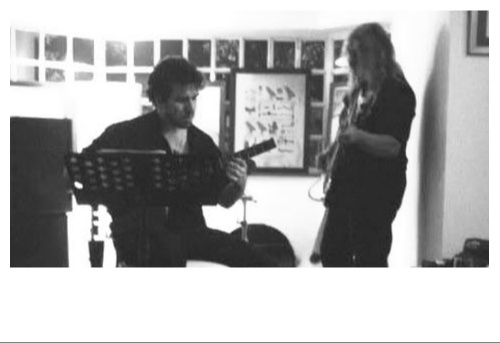
When we got together, we didn't rehearse: we simply played new music, the way two painters might meet to paint. Many times I tried to find ways to communicate with him and understand certain things — it was a challenge, and sometimes it was almost funny. There are no books for that.
"If you know something, you should pass it on." — Jorge Pasquali
His passing left me with that commitment to myself. The dilemma was how to explain it — simply, mixed with my own knowledge. I had been teaching since I was very young, but I cancelled that way of teaching and stopped giving classes. I focused solely on studying how to explain this — and that's not on the internet. I even looked into neuroscience, because the subject had fascinated me.
That is why my classes are in-person only (I can't explain this through a camera). A note: in my classes I don't explain scales or theory, because all of that is already within everyone's reach, even if sometimes learned in a scattered way. What I can do is explain how to use those tools, and what to do in different situations that come up when you play.
When I began playing with certain musicians, I learned to close my eyes, turn my awareness toward them, and simply listen and accompany them — as if walking by their side, without thinking about the audience. I needed to focus solely on the music. Although glances and subtle signals are useful for musical dialogue, for what I'm about to explain, none of that is necessary — because you are alone.
I have seen great guitarists and musicians from around the world do very difficult things, but when it came to sitting alone, without another musician to accompany them, they would often avoid it. Some guitarists struggle to sing a song using just their two hands, the way a pianist would. We tend to hesitate when we find ourselves in a situation we consider extreme: playing outside an established repertoire, without accompanying musicians, and creating something new — never before played, melodically and harmonically. No tricks, no rudiments, something simple, without hesitation, leaving space for an authentic melody to blossom: a song born in that precise moment.
I learned to do it naturally, and this great musician began to leave me alone, understanding that I flowed without effort. I began to study it, driven by the need to explain it to certain students, and by observing great musicians who, despite having a limited and rudimentary technique, could achieve it thanks to their strong musical cognitive capacity. But not everyone is born with that gift. For some, theory clouds their ability to focus on the flow of music; they think too much, and musicality loses its emotion.
Without thinking visually about where the note is going, and without the intention of making others hear something in particular. Personally, I learned that one must play for oneself. From the guitarist's point of view, it's about thinking in terms of melody and chords in dialogue — not necessarily in a chord-melody technique.
Over time, I managed to do all of this without thinking — simply flowing. You take that moment of solitude and let the magic happen.
Without underestimating technical level, I believe the depth with which you transmit music is more sincere when, in a certain way, you forget the instrument you're using. The instrument can limit us and physically pigeonhole us. But when you find the magic within yourself, you might discover something new you didn't know existed.
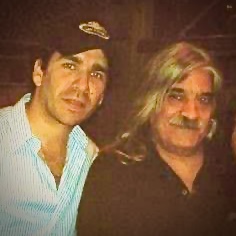
I didn't learn this by studying it — I learned it by doing it. I didn't discover anything, but I discovered myself alongside a genius.
Testimonials
"His playing is so beautiful!"
Suzie Collier
"His playing is simply beautiful!! Such a nice talented human being."
Manu Katché
"I like his touch. Very gentle and soulful."
Peter Sprague
"Good music. Nice playing."
Richard Bona
"Very good feeling."
Gary Brown (Grease movie)
"Excellent playing!"
Dale Turner — Guitar World Magazine
"German Herlein is a guitarist who can play convincingly in a variety of styles from straight ahead to jazz to acoustic latin flavored numbers with feeling and taste."
John Stowell
"Great sound and great tone."
Bucky Barrett
"Very beautiful playing."
Michael O'Neill
"I listened to his music and enjoyed it very much! Beautiful playing!"
Brent Mason
"Very nice 'Soberanes Cove'!"
Jorge Navarro
"What a nice touch!"
Mono Fontana
"German Herlein is a great guitarist with a great ability to adapt to various styles masterfully. I had the experience of having shared stages with him and he is a soulful musician."
Juanjo Hermida
When comments come on their own, without being asked for, they're genuine. It's not good to expect approval — just to understand that a compliment neither elevates nor diminishes who you are; it simply reveals a glimpse of how someone else sees you. And in that reflection, there is always room to grow.
— German